Are Bald Men Less Attractive? 15,731 Women Rated 2,957 Men
Does going bald make men less attractive? We analyzed 181,766 ratings from 15,731 women to find out.
 By The Photoeval teamPublished 9 min readBased on 181,766 ratings
On this page
- 1.The short answer: yes, but less than you might think
- 2.How much does hair loss affect male attractiveness?
- 3.Does the stage of baldness make a difference?
- 4.Does age make baldness less of a disadvantage?
- 5.Can a beard make bald men more attractive?
- 6.Can being muscular compensate for baldness?
- 7.Do bald men actually get fewer dates?
- 8.So, should you worry about going bald?
- 9.How we conducted this study
The results reveal a clear age difference: hair loss has a noticeable impact on men's attractiveness before 33, but much less after. A beard helps narrow the gap, while being muscular brings balding men close to the average man their age with full hair.
The short answer: yes, but less than you might think
Losing your hair does affect how women rate your appearance. But the difference is relatively small, and it depends much more on your age and overall appearance than on baldness alone.
In our study, women rated men with a full head of hair 4.8 out of 10 on average, compared with 4.3 for balding men. However, balding men were older on average (37 versus 30), and age itself affects attractiveness ratings.
When we compare men with others their own age, the difference falls to approximately 0.3 points out of 10.
That is a relatively modest penalty. More importantly, it is not the same at every age:
- Under 33: Balding men score about 0.7 points lower than men their age with full hair.
- Age 33 and over: The difference falls to approximately 0.1 points, a gap too small to be sure it isn't chance.
There are also two encouraging findings for balding men: a beard more than halves the attractiveness gap, and muscular men are rated close to the average man their age who still has a full head of hair.
Let's look at what the data actually shows.
How much does hair loss affect male attractiveness?
To understand the impact of baldness, we need to separate two things: the difference between groups overall and the difference between men of the same age.
At first glance, the numbers suggest a substantial gap:
| Hair | Average rating |
|---|---|
| Full head of hair | 4.8/10 |
| Balding | 4.3/10 |
Average rating by women, out of 10. Men with full hair are 30 on average, balding men 37. 2,957 men, one photo each, rated by at least 20 women. Photoeval, 2021 to 2026.
But balding men were seven years older on average. Comparing these two groups directly would therefore exaggerate the effect of hair loss.
Instead, we compared each man with men of his own age who had a full head of hair.
The result: hair loss comes with a penalty of approximately 0.3 points out of 10.
To make this difference easier to understand, we also looked at how many men were rated above the average man their age with full hair.
Among men with a full head of hair, approximately half scored above that average, as expected. Among balding men, only about one in three did.
This suggests that hair loss does have a measurable effect, but it is far from determining how attractive a man is.
Does the stage of baldness make a difference?
Not all hair loss looks the same. A slightly receding hairline is very different from a completely bald crown or advanced baldness.
We therefore separated men according to the stage of hair loss they reported, using descriptions corresponding approximately to the Norwood scale.
The most interesting finding is that a receding hairline alone appears to have little impact. Ratings fall more noticeably once thinning becomes visible on the crown.
Here is how the different stages compare:
 Full hairStage 1
- 49%
- Very slight thinningStage 1
- 47%
 Receding hairline, thinner crownStage 2
- 41%
 More hair loss at the crownStage 3
- 35%
 Bald crown, temples or frontStages 4–5
- 37%
 Advanced or extreme baldnessStages 6–7
- 27%
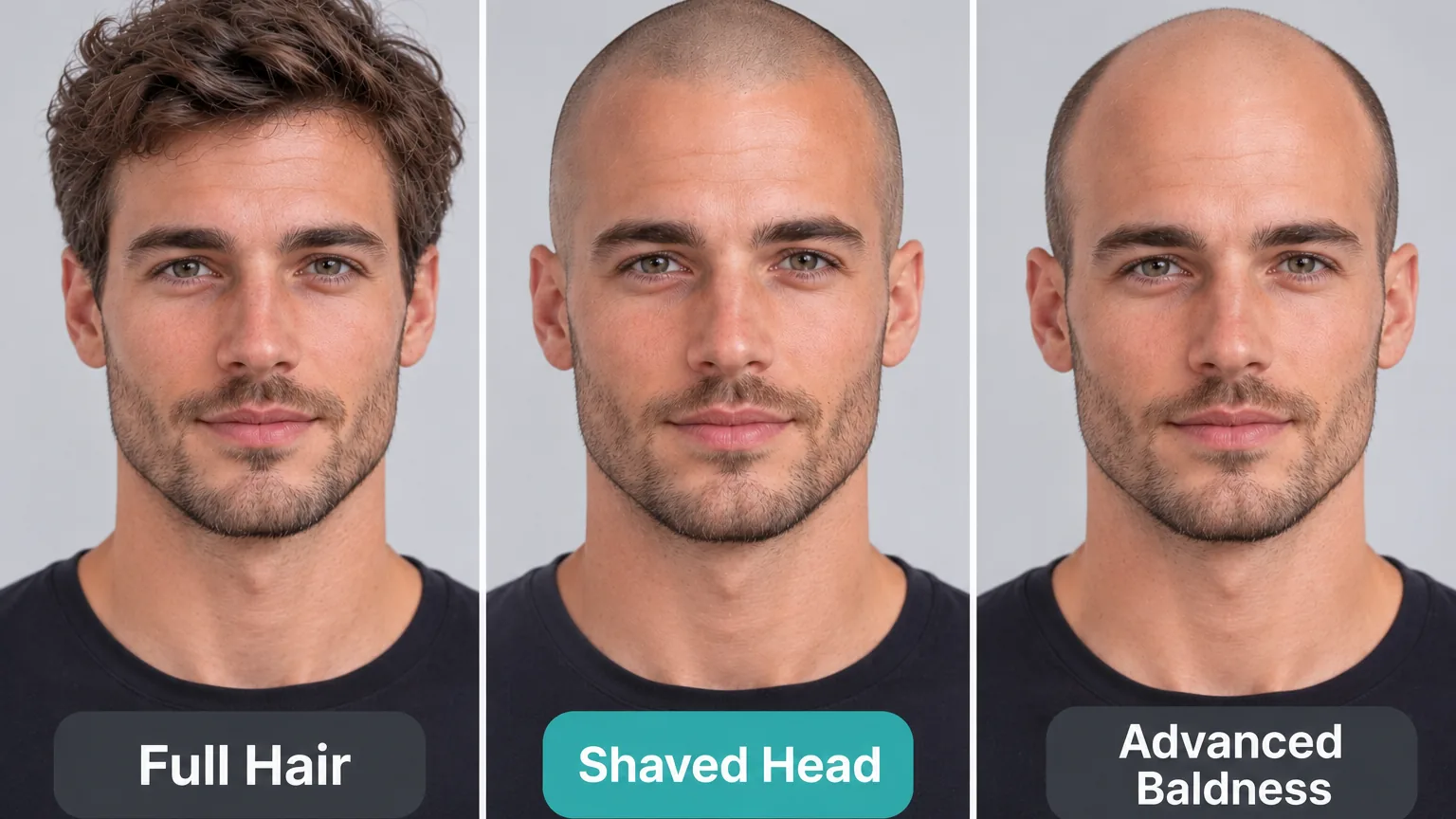
- Shaved head (by choice)
- 38%
2,957 men aged 18 to 60, one photo each, rated by at least 20 women; hair as each man described it. Drawings (illustrative): the Norwood stage closest to each answer. Few men at each stage beyond a receding hairline (33 with advanced baldness), so those bars are approximate. Photoeval, 2021 to 2026.
The pattern is not perfectly linear, but the overall trend is clear: the more advanced the hair loss, the lower the ratings.
Men with advanced baldness have the lowest result. Only 27% are rated above the average man their age with full hair.
Interestingly, men who shave their heads perform better than those with advanced natural baldness (38% versus 27%). With only 33 men with advanced baldness, this difference could still be due to chance.
This does not prove that shaving your head makes you more attractive. But it suggests that a deliberately shaved look may be perceived differently from visible, advanced hair loss.
One important distinction: these percentages measure the share of men rated above the average man their age with full hair, not the percentage of women who find bald men attractive. They should not be interpreted as a direct measure of women's preferences.
Does age make baldness less of a disadvantage?
This is one of the strongest findings in our study.
Hair loss appears to matter considerably more when men are young. Once men reach their thirties, the difference between those with and without hair becomes much smaller.
Among men under 33, those who are balding are rated approximately 0.7 points lower than their peers with full hair.
Among men aged 33 and over, the difference is only around 0.1 points.
The same pattern appears when we look at the share of men rated above the average man their age with full hair:
Under 3333 and over
- Full hair
- 48%49%
- Balding
- 23%40%
- Shaved head
- 29%41%
Same 2,957 men, one photo each, rated by at least 20 women. Under 33, only 47 men are balding and 48 shave their head, so those bars are approximate. Photoeval, 2021 to 2026.
Before 33, fewer than one in four balding men score above the average man their age with full hair. After 33, that proportion rises to 40%.
Why does this happen?
One possible explanation is that hair loss is less unusual as men get older. At 25, a receding hairline or thinning crown can make a man stand out among his peers. At 45, hair loss is much more common, so it may stand out less.
This is a plausible explanation, not something our data can establish directly.
The important takeaway is that the attractiveness penalty that comes with hair loss is not constant throughout a man's life. It is much stronger in younger men.
Can a beard make bald men more attractive?
Yes. Our data suggests that facial hair can significantly narrow the attractiveness gap that comes with hair loss.
We compared balding men and men who shave their heads, separating those with facial hair from those who were clean-shaven.
The difference was substantial:
Clean-shavenStubble or beard
- Full hair or receding hairline
- 45%49%
- Balding or shaved head
- 28%39%
Same 2,957 men; balding or shaved head counted together (too few men in each to split them by beard), facial hair as each man described it. Photoeval, 2021 to 2026.
The gap with men who still have their hair shrinks from 17 men in 100 to 10 when facial hair is present.
In terms of average attractiveness ratings, the difference between balding or shaved men and men their age with full hair is approximately:
- Clean-shaven: 0.4 points.
- With stubble or a beard: 0.15 points.
In other words, the difference is reduced by more than half.
Interestingly, facial hair makes relatively little difference among men who already have a full head of hair or just a receding hairline.
We cannot establish why this happens from the data alone. One possibility is that facial hair adds definition and structure to the lower half of the face, creating a more balanced overall appearance.
Whatever the explanation, the numbers suggest that growing a beard or maintaining stubble may be worth considering if you are losing your hair.
Can being muscular compensate for baldness?
Body shape is another important factor, and the results are particularly encouraging.
Muscular men receive higher attractiveness ratings regardless of their hair. But for balding men, the difference is especially meaningful.
Here is the share of men rated above the average man their age with full hair:
Average bodyMuscular
- Full hair
- 42%60%
- Balding
- 25%54%
- Shaved head
- 22%48%
Same 2,957 men, body as each man described it. Only 37 muscular balding men, so that bar is approximate; slim and overweight men are not shown. Photoeval, 2021 to 2026.
Among men with an average body, only 25% of balding men are rated above the average man their age with full hair.
Among muscular men, that proportion rises to 54%.
A muscular balding man is therefore rated close to the average man his age who still has a full head of hair.
This does not mean that muscle completely cancels out the effect of hair loss. Muscular men with full hair still perform better than muscular balding men.
But it does show that physical appearance is not determined by hair alone.
In fact, among men with full hair, overweight men score approximately 0.6 points below the average man their age.
The broader lesson is that overall appearance matters. Hair is one component of attractiveness, not the whole picture.
Do bald men actually get fewer dates?
Here is where the results become particularly interesting.
Despite receiving slightly lower attractiveness ratings, balding men do not report going on fewer dates.
We also examined the dating histories reported by 9,187 men in our dataset, including men whose photos were not rated.
After accounting for age, the average number of women dated over the previous 12 months was:
- Full hair
- 2.1
- Balding
- 2.3
- Shaved head
- 2.3
- Receding hairline
- 1.7
Average number of women dated in the past 12 months, as reported by each man (answers above 20 counted as 20), compared at the same age. 9,187 men, including those whose photo was not rated. Photoeval, 2021 to 2026.
The differences between men with full hair, balding men and those with shaved heads are small enough that they could be due to chance.
Men with a receding hairline reported slightly fewer dates, but our data does not explain why.
We also found a much clearer relationship between how women rated a man's photo and the number of dates he reported.
Men whose photos received higher ratings reported more dates:
- Below 3.5/10
- 1.6
- 3.5 to below 4.5
- 2.1
- 4.5 to below 5.5
- 2.5
- 5.5 or above
- 3.5
Average number of women dated in the past 12 months, as reported by each man (answers above 20 counted as 20), by his photo's average rating from women, out of 10. 2,957 men, one photo each, rated by at least 20 women; not adjusted for age. Photoeval, 2021 to 2026.
Men in the highest-rated group reported more than twice as many dates as those in the lowest-rated group.
This is a correlation, not proof that a higher photo rating causes more dates. Other factors may explain part of the relationship, and we cannot establish which comes first.
Nevertheless, the contrast is interesting: hair loss goes with a relatively small difference in attractiveness ratings, while how women rate a man's photo goes much more strongly with the number of dates he reported.
So, should you worry about going bald?
The data suggests that losing your hair does have an impact on male attractiveness, but it is not nearly as decisive as many men fear.
Three findings stand out:
- Age changes everything. Hair loss has a noticeable impact before 33, but the difference is almost negligible among older men.
- Your overall appearance matters. Being muscular brings balding men close to the average attractiveness level of men their age with full hair.
- A beard can help. Balding or shaved men with facial hair have a considerably smaller attractiveness gap than clean-shaven ones.
There is also an important distinction between advanced natural baldness and a shaved head. Our data suggests that the latter performs somewhat better.
Ultimately, a woman's impression of a man comes from his overall appearance: his face, physique, facial hair, grooming, expression and the way he presents himself in a photo.
You cannot control every aspect of your appearance, but you can control how you present it.
And if you are wondering how attractive your own photo looks to women, you do not have to guess.
How we conducted this study
This study is based on anonymized data collected on Photoeval between 2021 and 2026.
We analyzed 2,957 men, each represented by one photo rated by at least 20 women. In total, 15,731 women contributed to the study, generating 181,766 ratings.
Men reported their age, hair-loss stage, facial hair and body type through a questionnaire. We compared their ratings with those of men of the same age who reported having a full head of hair.
At the time, Photoeval used a rating scale from 1 to 5. All ratings were converted to a scale from 1 to 10 for this analysis.
The dating analysis uses self-reported information from a wider sample of 9,187 men, including those whose photos were not rated. Reported dating counts above 20 were capped at 20.
Some subgroup results should be interpreted cautiously. In particular, only 33 men had advanced baldness, 37 balding men were muscular, and 47 men under 33 were balding. Results for these smaller groups are approximate.
The findings describe how women rated profile photos, not how they would respond to meeting the men in person. The results also reflect Photoeval's user base, which is younger than the general population, with the largest groups of users coming from the United States and the United Kingdom.
The study identifies associations, not causal effects. Differences that are small or based on limited samples should not be interpreted as established effects.